> ## Documentation Index
> Fetch the complete documentation index at: https://docs.metabind.ai/llms.txt
> Use this file to discover all available pages before exploring further.
# Inspector property reference
> Configure how each BindJS property appears in the visual builder — control types, options, and per-type extensions
The **inspector** is the visual builder inside MCP App Studio that lets non-developers configure components without touching code. Every BindJS property can opt into specific inspector controls (sliders, dropdowns, multi-line inputs, etc.) by adding an `inspector` block to its definition. This page is the reference for every supported `control` and option.
## Where the inspector lives
When a component is bound to a Type, the Type's edit page shows an inspector form generated from the component's `properties`. Editors fill the form; the values flow through to the rendered component on save.
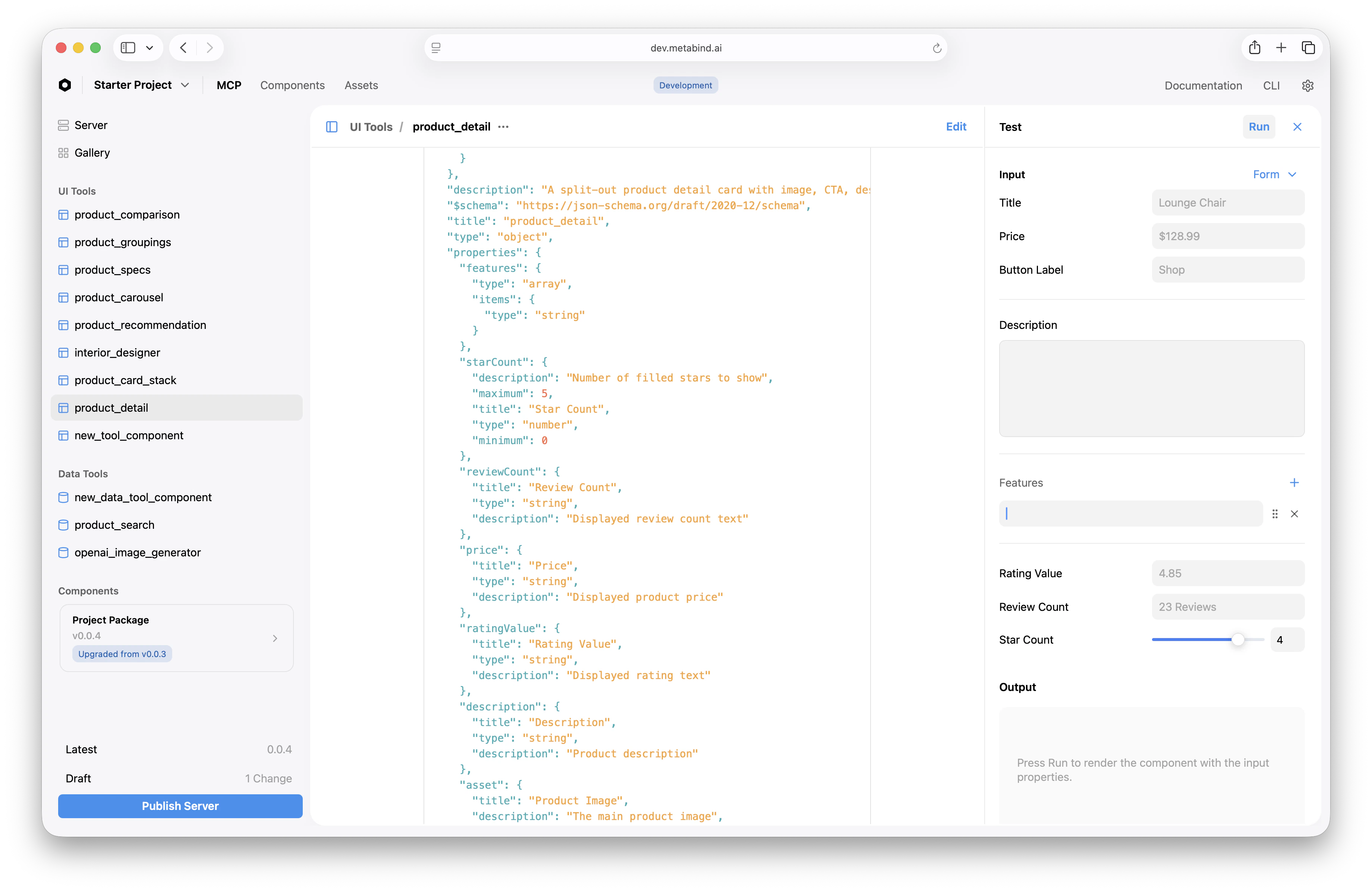 The inspector is part of MCP App Studio, not part of the BindJS rendering runtime. It exists to give content editors and non-developer team members a safe surface for editing tool inputs.
## Common options (all property types)
These options apply to every property's `inspector` block, regardless of type:
| Option | Type | Purpose |
| ----------------- | -------------------- | ----------------------------------------------------------------- |
| `showLabel` | `boolean` | Show or hide the field label in the inspector. Default `true`. |
| `showDivider` | `boolean` | Show a divider line above this field — useful for grouping. |
| `helpDescription` | `string` | One-line help text shown beneath the field. |
| `visible` | `(props) => boolean` | Conditionally show the field based on the values of other fields. |
```ts theme={null}
properties: {
starCount: {
type: "number",
title: "Star Count",
inspector: {
control: "slider",
step: 1,
showDivider: true,
helpDescription: "Number of stars to display in the rating."
}
}
}
```
## `control` values by property type
The `control` option determines the inspector UI. Valid values depend on the property's `type`.
### `string` properties
| `control` | UI |
| ------------ | ----------------------------------------------- |
| `singleline` | Single-line text input. Default for `string`. |
| `multiline` | Multi-line text area. |
| `code` | Monospace code editor with syntax highlighting. |
String-specific options:
| Option | Type | Purpose |
| --------------- | --------- | --------------------------------------------- |
| `placeholder` | `string` | Placeholder text shown when empty. |
| `markdown` | `boolean` | Enable a formatting toolbar (multiline only). |
| `numberOfLines` | `number` | Initial height in lines for multiline. |
```ts theme={null}
properties: {
description: {
type: "string",
title: "Description",
inspector: {
control: "multiline",
numberOfLines: 4,
placeholder: "Describe the product…",
markdown: true
}
}
}
```
### `number` and `integer` properties
| `control` | UI |
| --------- | -------------------------------------- |
| `slider` | Slider with min/max from `validation`. |
| `input` | Numeric input field. Default. |
Number-specific options:
| Option | Type | Purpose |
| ------ | -------- | -------------------------------- |
| `step` | `number` | Increment for slider or stepper. |
```ts theme={null}
properties: {
rating: {
type: "number",
title: "Rating",
validation: { min: 0, max: 5 },
inspector: { control: "slider", step: 0.5 }
}
}
```
### `enum` properties
| `control` | UI |
| ----------- | ----------------------------------------- |
| `segmented` | Segmented control (good for ≤ 4 options). |
| `dropdown` | Standard dropdown. Default. |
```ts theme={null}
properties: {
size: {
type: "enum",
title: "Size",
values: ["small", "medium", "large"],
inspector: { control: "segmented" }
}
}
```
### `boolean` properties
Booleans render as a toggle switch automatically — no explicit `control` value is needed. Use `inspector` to add a `helpDescription` or to gate visibility.
```ts theme={null}
properties: {
featured: {
type: "boolean",
title: "Featured",
inspector: { helpDescription: "Show this item in the featured shelf." }
}
}
```
### `date` properties
Dates render as a date picker. There is no `control` option — instead, use `placeholder` or other top-level inspector options.
### `asset` properties
Asset properties render as an asset picker that opens the project's asset library. The picker filters by the property's `assetTypes` (e.g., `["image"]`, `["video"]`, `["model"]`).
```ts theme={null}
properties: {
hero: {
type: "asset",
title: "Hero Image",
assetTypes: ["image"]
}
}
```
### `array` properties
Arrays render as a repeatable group with **+ Add** and **−** controls. Each item uses the `valueType`'s inspector configuration. For arrays of components (`valueType: { type: "component" }`), the picker filters by `allowedComponents`.
### `component` properties
Component properties render as a typed picker showing only the components on the slot's `allowedComponents` list. Picking one inserts the component reference; double-clicking opens its inspector.
### `group` properties
Groups render as nested forms inside a collapsible section. Each nested property uses its own inspector configuration.
## Conditional visibility (`visible`)
The `visible` callback runs every time the component's values change. Use it to hide fields that don't apply to the current state:
```ts theme={null}
properties: {
variant: {
type: "enum",
values: ["solid", "outline", "ghost"],
title: "Variant"
},
borderWidth: {
type: "number",
title: "Border Width",
inspector: {
control: "slider",
step: 1,
visible: (props) => props.variant === "outline"
}
}
}
```
## Layout grouping
Use `showDivider: true` on the first property of a logical group to visually separate it from the previous group. There is no explicit "group" wrapper — dividers do the work.
For nested groups (a property whose type is `group`), the inspector renders the nested fields in a collapsible section.
## Validation
`inspector` configures appearance and editor UX, not constraints. Constraints live under the property's separate `validation` block:
```ts theme={null}
properties: {
count: {
type: "number",
title: "Count",
validation: { min: 1, max: 50 }, // enforced server-side
inspector: { control: "slider", step: 1 } // appearance only
}
}
```
The platform validates against `validation` before any tool call resolves, regardless of what the inspector showed the editor.
## Related
The visual development surface the inspector lives in.
Where you write the property definitions the inspector renders.
Property type reference: `string`, `number`, `enum`, `array`, `group`, etc.
How `validation` constraints are enforced on every tool call.
The inspector is part of MCP App Studio, not part of the BindJS rendering runtime. It exists to give content editors and non-developer team members a safe surface for editing tool inputs.
## Common options (all property types)
These options apply to every property's `inspector` block, regardless of type:
| Option | Type | Purpose |
| ----------------- | -------------------- | ----------------------------------------------------------------- |
| `showLabel` | `boolean` | Show or hide the field label in the inspector. Default `true`. |
| `showDivider` | `boolean` | Show a divider line above this field — useful for grouping. |
| `helpDescription` | `string` | One-line help text shown beneath the field. |
| `visible` | `(props) => boolean` | Conditionally show the field based on the values of other fields. |
```ts theme={null}
properties: {
starCount: {
type: "number",
title: "Star Count",
inspector: {
control: "slider",
step: 1,
showDivider: true,
helpDescription: "Number of stars to display in the rating."
}
}
}
```
## `control` values by property type
The `control` option determines the inspector UI. Valid values depend on the property's `type`.
### `string` properties
| `control` | UI |
| ------------ | ----------------------------------------------- |
| `singleline` | Single-line text input. Default for `string`. |
| `multiline` | Multi-line text area. |
| `code` | Monospace code editor with syntax highlighting. |
String-specific options:
| Option | Type | Purpose |
| --------------- | --------- | --------------------------------------------- |
| `placeholder` | `string` | Placeholder text shown when empty. |
| `markdown` | `boolean` | Enable a formatting toolbar (multiline only). |
| `numberOfLines` | `number` | Initial height in lines for multiline. |
```ts theme={null}
properties: {
description: {
type: "string",
title: "Description",
inspector: {
control: "multiline",
numberOfLines: 4,
placeholder: "Describe the product…",
markdown: true
}
}
}
```
### `number` and `integer` properties
| `control` | UI |
| --------- | -------------------------------------- |
| `slider` | Slider with min/max from `validation`. |
| `input` | Numeric input field. Default. |
Number-specific options:
| Option | Type | Purpose |
| ------ | -------- | -------------------------------- |
| `step` | `number` | Increment for slider or stepper. |
```ts theme={null}
properties: {
rating: {
type: "number",
title: "Rating",
validation: { min: 0, max: 5 },
inspector: { control: "slider", step: 0.5 }
}
}
```
### `enum` properties
| `control` | UI |
| ----------- | ----------------------------------------- |
| `segmented` | Segmented control (good for ≤ 4 options). |
| `dropdown` | Standard dropdown. Default. |
```ts theme={null}
properties: {
size: {
type: "enum",
title: "Size",
values: ["small", "medium", "large"],
inspector: { control: "segmented" }
}
}
```
### `boolean` properties
Booleans render as a toggle switch automatically — no explicit `control` value is needed. Use `inspector` to add a `helpDescription` or to gate visibility.
```ts theme={null}
properties: {
featured: {
type: "boolean",
title: "Featured",
inspector: { helpDescription: "Show this item in the featured shelf." }
}
}
```
### `date` properties
Dates render as a date picker. There is no `control` option — instead, use `placeholder` or other top-level inspector options.
### `asset` properties
Asset properties render as an asset picker that opens the project's asset library. The picker filters by the property's `assetTypes` (e.g., `["image"]`, `["video"]`, `["model"]`).
```ts theme={null}
properties: {
hero: {
type: "asset",
title: "Hero Image",
assetTypes: ["image"]
}
}
```
### `array` properties
Arrays render as a repeatable group with **+ Add** and **−** controls. Each item uses the `valueType`'s inspector configuration. For arrays of components (`valueType: { type: "component" }`), the picker filters by `allowedComponents`.
### `component` properties
Component properties render as a typed picker showing only the components on the slot's `allowedComponents` list. Picking one inserts the component reference; double-clicking opens its inspector.
### `group` properties
Groups render as nested forms inside a collapsible section. Each nested property uses its own inspector configuration.
## Conditional visibility (`visible`)
The `visible` callback runs every time the component's values change. Use it to hide fields that don't apply to the current state:
```ts theme={null}
properties: {
variant: {
type: "enum",
values: ["solid", "outline", "ghost"],
title: "Variant"
},
borderWidth: {
type: "number",
title: "Border Width",
inspector: {
control: "slider",
step: 1,
visible: (props) => props.variant === "outline"
}
}
}
```
## Layout grouping
Use `showDivider: true` on the first property of a logical group to visually separate it from the previous group. There is no explicit "group" wrapper — dividers do the work.
For nested groups (a property whose type is `group`), the inspector renders the nested fields in a collapsible section.
## Validation
`inspector` configures appearance and editor UX, not constraints. Constraints live under the property's separate `validation` block:
```ts theme={null}
properties: {
count: {
type: "number",
title: "Count",
validation: { min: 1, max: 50 }, // enforced server-side
inspector: { control: "slider", step: 1 } // appearance only
}
}
```
The platform validates against `validation` before any tool call resolves, regardless of what the inspector showed the editor.
## Related
The visual development surface the inspector lives in.
Where you write the property definitions the inspector renders.
Property type reference: `string`, `number`, `enum`, `array`, `group`, etc.
How `validation` constraints are enforced on every tool call.