

What you’ll build
The Oak & Ivory sample is a retail MCP App for an interior-design brand. It includes:- 8 Interactive Tools that render UI:
product_detail,product_carousel,product_groupings,product_comparison,product_recommendation,product_specs,product_card_stack, andinterior_designer. - 2 Data Tools that fetch data:
product_search(semantic search over the Oak & Ivory catalog) andopenai_image_generator. - Project instructions that tell the AI how and when to use each tool — for example, “If the user wants to see a single product, use
product_detail. If the user wants to compare products, useproduct_comparison.”
product_search to fetch matching items, then calls product_detail to render one inline. The renderer compiles the BindJS component, validates the AI’s response against the tool’s schema, and displays a native-looking product card in the chat.
Prerequisites
- A Metabind account. Create one if you haven’t yet.
- Claude Desktop installed locally.
Step 1: Create a project from the Oak & Ivory sample
1
Sign in
Open www.metabind.ai and sign in.
2
Create a new project
From the project picker, choose New project. The sample picker offers a blank starter and Oak & Ivory. Pick Oak & Ivory.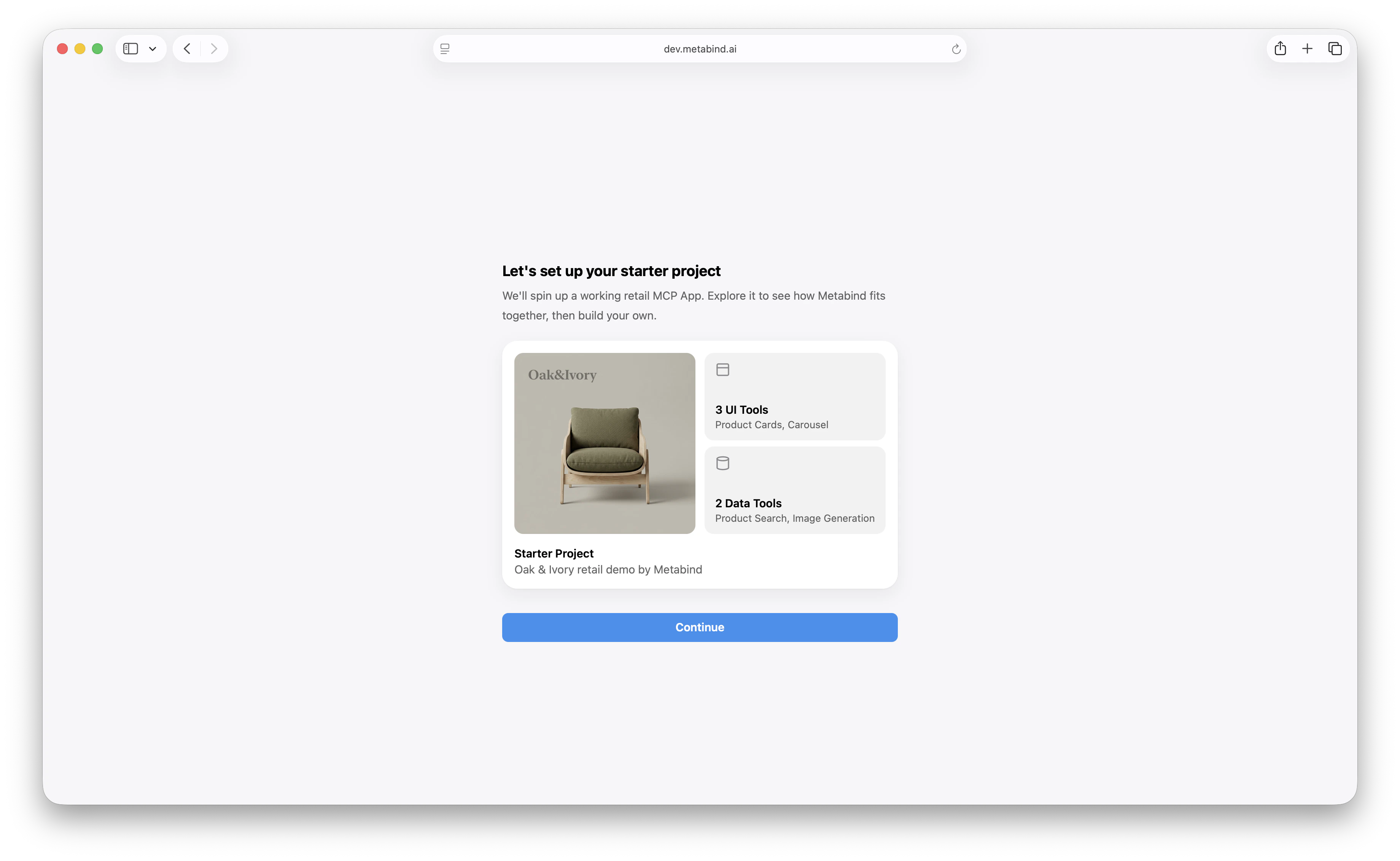
3
Open the project
The project loads with all eight Interactive Tools, both Data Tools, the component package, and the AI instructions already configured.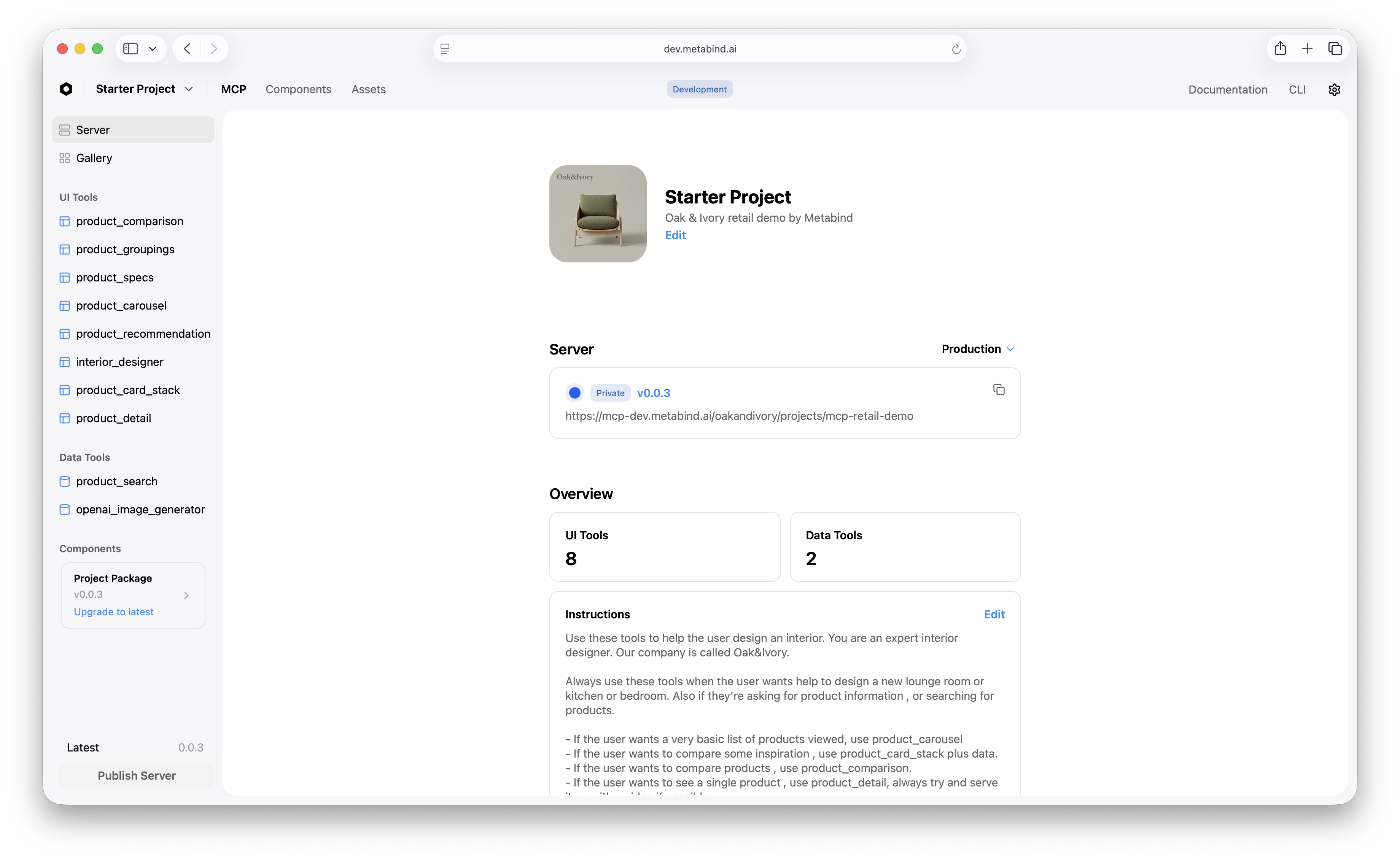
- Server, Connect, Gallery — project-level settings, MCP server URLs, and the asset gallery.
- UI Tools — Interactive Tools, the ones that render UI when the AI calls them.
- Data Tools — handlers that fetch data, run in V8 sandboxes with secrets injected at runtime.
- Components — the BindJS source for everything the tools render.
product_detail when the user wants to see a single product, and always serve it up with a video if there is one.”
Step 2: Test a tool inline
Before connecting Claude Desktop, run a tool from inside Metabind Studio to see what the AI will see.1
Open product_detail
In the UI Tools sidebar, click
product_detail. The center pane shows the rendered preview; the right pane is the test panel.2
Fill the test inputs
Enter values for
Title, Price, Button Label, Description, and the other inputs. The defaults from the preview already produce a reasonable lounge chair.3
Run
Click Run. The platform validates your input against the tool’s schema, compiles the BindJS to a renderable bundle, and displays the result.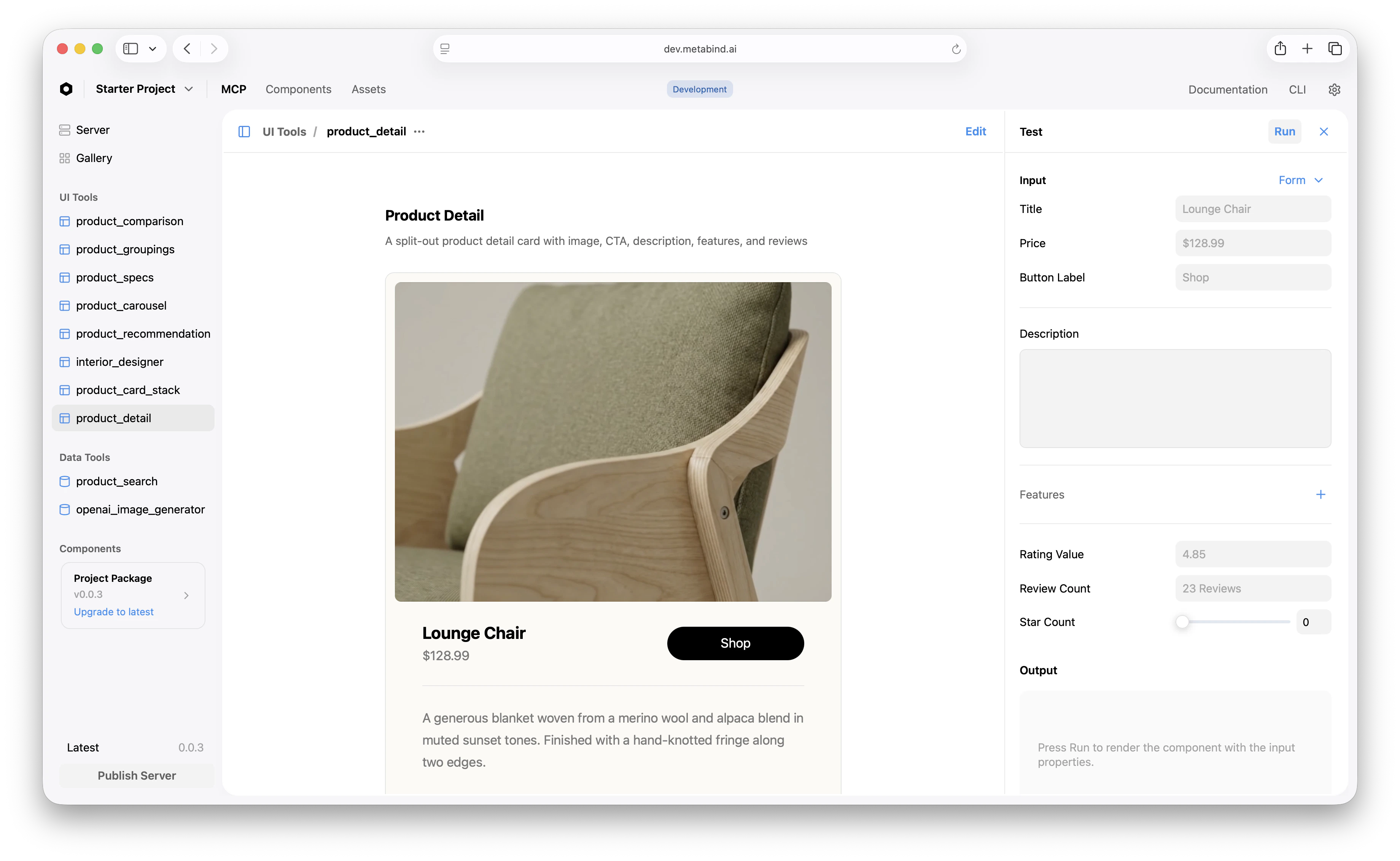
Step 3: Inspect the BindJS source (optional)
Skip this step if you want to keep moving. It’s worth a glance, though, because every Interactive Tool in Oak & Ivory is a BindJS component you can read and edit directly in Metabind Studio.1
Switch to the Components tab
Click Components in the top navigation. The sidebar lists every component the project ships, including
ProductDetail, ProductCarousel, ProductSearch, and shared primitives like BrandBackground and ColorInfo.2
Open ProductDetail
Click 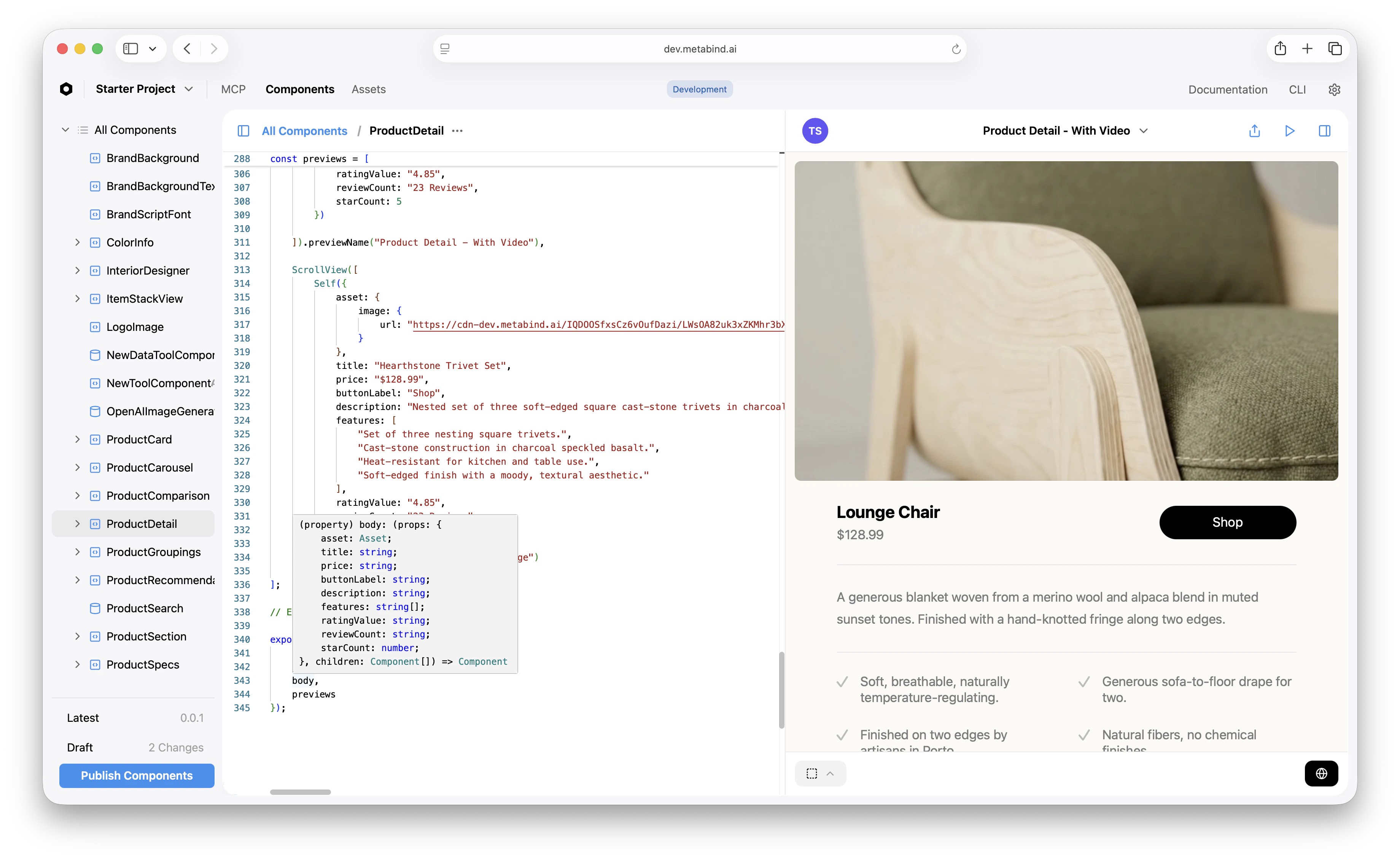
ProductDetail. The code editor shows the BindJS source; the right pane shows live previews driven by the previews array at the bottom of the file.Step 4: Connect to Claude Desktop using the draft URL
You don’t need to publish to test. Every project has a draft endpoint that exposes every tool — published, modified, and unpublished — for development. Point Claude Desktop at the draft URL first; you’ll publish to production once it’s working.1
Copy the draft URL
On the Server tab in Metabind Studio, switch the endpoint dropdown to Draft and copy the URL.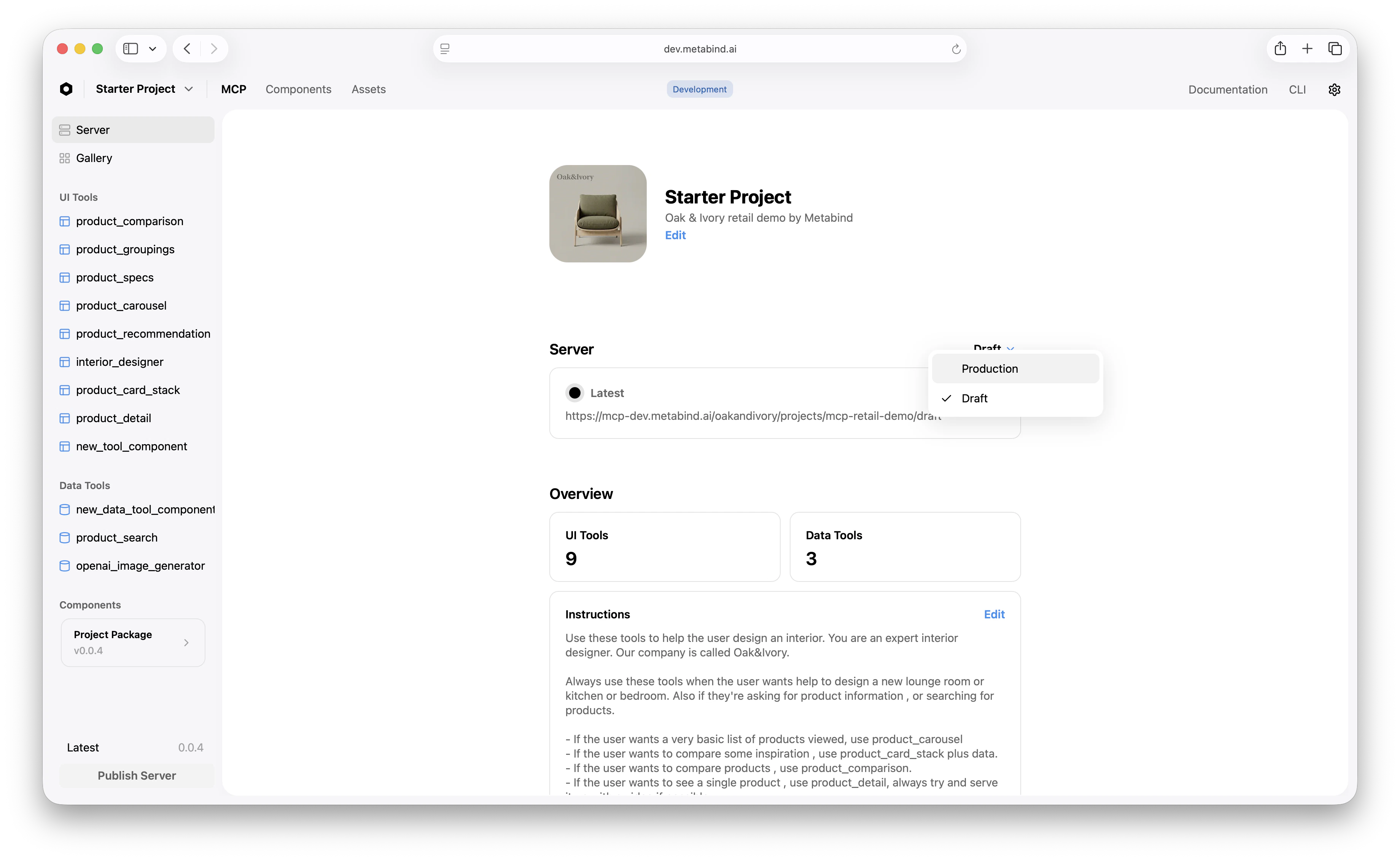
2
Add a custom connector in Claude Desktop
Open Claude → Settings → Connectors → Add custom connector, paste the draft URL, and click Add.
3
Authorize Claude Desktop
The new connector appears with a Connect button. Click it. Claude Desktop opens a Metabind authorization page — sign in if you aren’t already, then click Authorize.The popup closes and the connector flips to Connected. Your project’s tools are now available in Claude Desktop conversations.
Step 5: Try it
In Claude Desktop, start a new conversation and try one of these:- “Show me a coffee table from Oak & Ivory.”
- “I’m decorating a small living room — recommend three accent pieces.”
- “Compare the Heritage Walnut and Ivory Oak coffee tables.”
product_search to find matching items, then call an Interactive Tool — usually product_detail, product_carousel, or product_comparison — to render the result. The rendered card appears inline in the conversation, not as a JSON dump.
Behind the scenes, every render goes through schema validation against the tool’s input schema, and only components from the project’s published package can appear. That’s the governance baseline: the AI cannot inject components you didn’t approve, on any surface.
Step 6: Publish to production
When the draft is working the way you want, publish:1
Click Publish Server
The button is at the bottom-left of the project sidebar. The pending-changes counter resets to zero.
2
Switch Claude Desktop to the production URL
Add a second custom connector in Claude → Settings → Connectors using the Production URL from the Server tab, and authorize it. The production URL is what you give to anyone you want to share the MCP App with — they paste it, click Connect, and authorize with their own Metabind login.
modified status — the production endpoint continues to serve the last published version while the draft endpoint shows the working copy. You can iterate without breaking what’s already live.
What you’ve built
In a few minutes you have:- A live MCP App on
mcp.metabind.aithat any MCP host can connect to. - Eight Interactive Tools that render schema-validated native UI rather than text returns.
- Two Data Tools that proxy your APIs through V8-sandboxed handlers with runtime-injected secrets.
- A production endpoint and a draft endpoint, with publish-and-rollback already wired in.
What to read next
Customize the components
Edit the Oak & Ivory components or write your own with BindJS.
Add a Data Tool
Wrap one of your own REST or GraphQL endpoints as an MCP tool.
Connect to other MCP hosts
Use the same MCP App in ChatGPT and any other MCP-compatible host.
Embed in your own app
Ship the same MCP App as a native AI assistant in iOS, Android, or web.